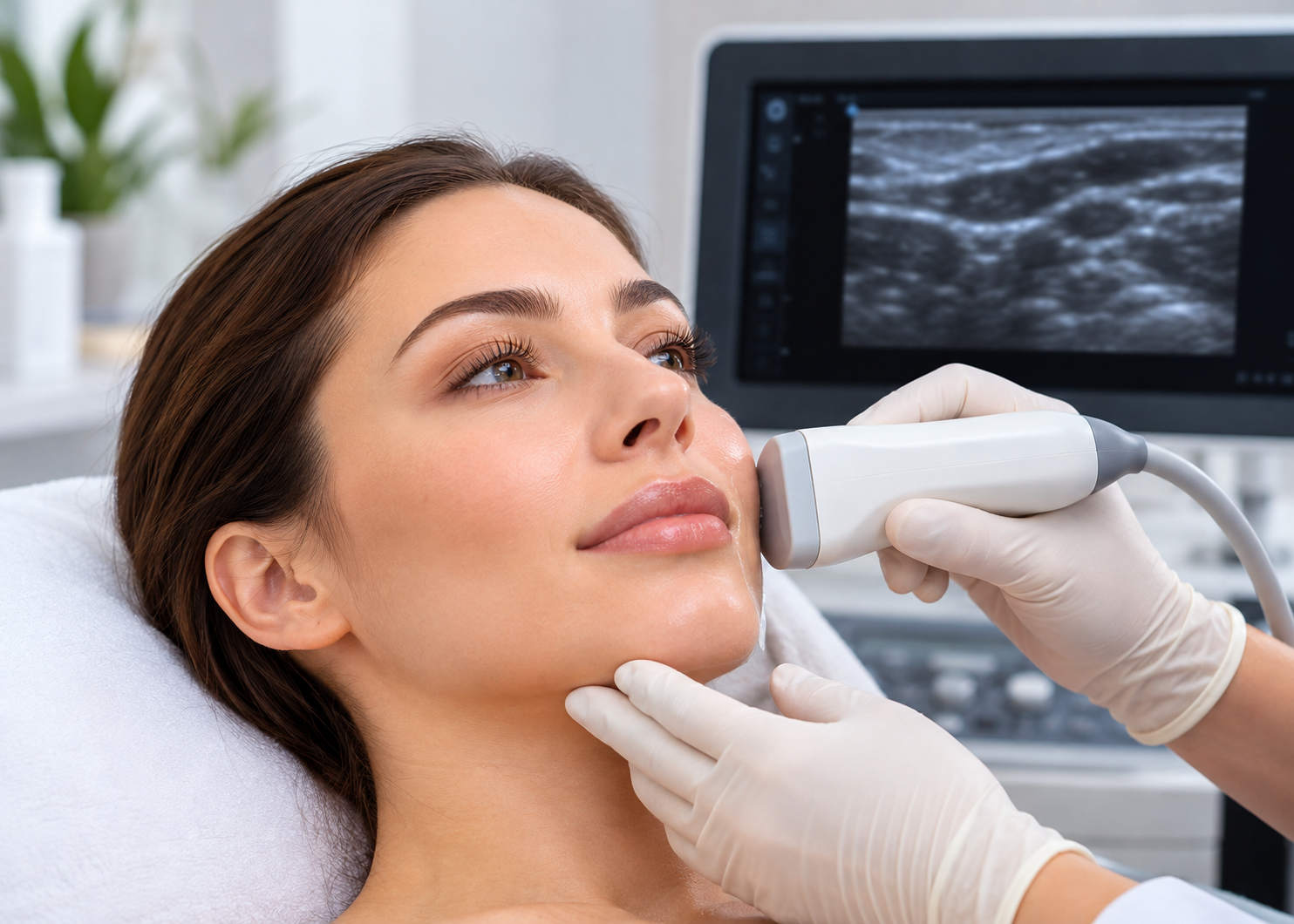
Filler migration is a condition in which injected dermal filler moves beyond its intended treatment area into nearby tissues. This may cause unwanted fullness, uneven contours, or changes in facial appearance. Common factors include injection technique, product volume, and individual anatomy. Ultrasound can help practitioners locate existing filler and assess its position. Although it cannot guarantee prevention, imaging supports more informed treatment decisions.
Professional guidance can help you understand your treatment options and plan your next steps. At Sadiya Clinic, you can discuss your concerns and explore suitable aesthetic treatments with a qualified provider. Concierge services offer added convenience for eligible treatments, subject to availability and applicable fees. Schedule a consultation today to discuss your needs and confirm suitable care options.
How Is Filler Migration Different From Overfilled Lips?
Filler migration occurs when injected material moves beyond its original placement, while overfilled lips result from excessive volume. Both conditions can change lip shape, but their underlying issues differ. Migration involves displacement into nearby tissues. Overfilling means too much product creates an enlarged appearance, even when the filler remains in its intended location.
A study in Dermatologic Surgery [1] used ultrasound to examine filler deposits across different tissue layers. Researchers identified migration in five of 27 patients with noninflammatory filler nodules. These findings show how imaging can reveal the location of injected material. However, the study did not directly compare migration with overfilled lips, so clinical assessment remains important when distinguishing these concerns.
What Causes Filler to Migrate?
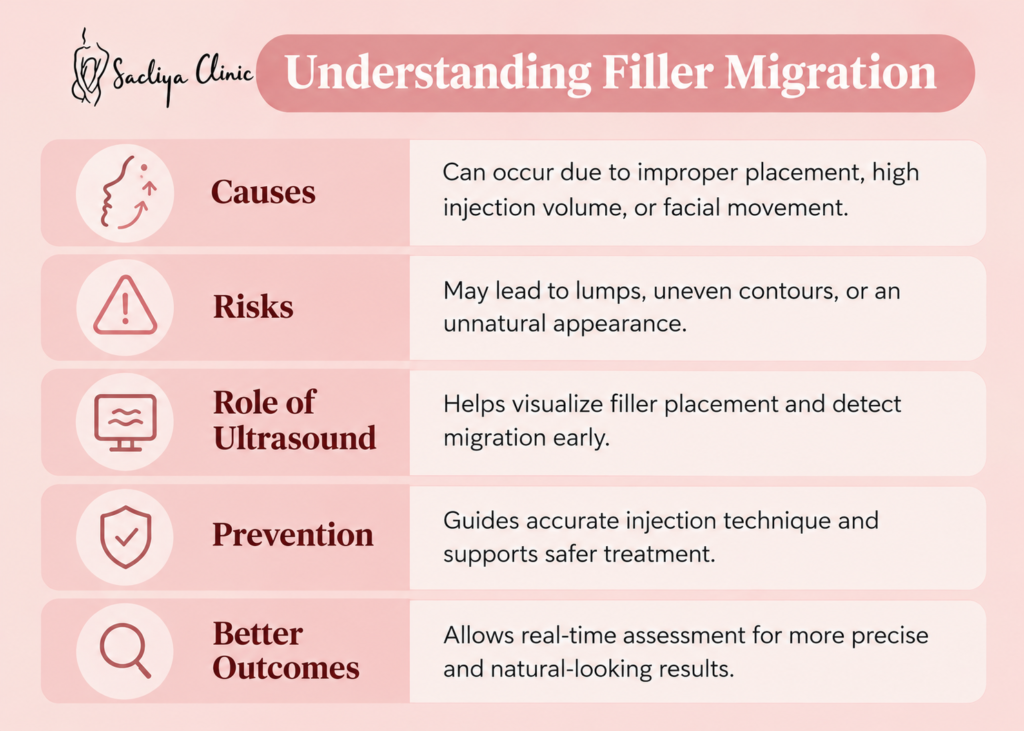
Filler migration can result from excessive product volume, incorrect injection depth, poor placement, and repeated treatments. Facial movement and individual tissue structure may also affect filler distribution. In some cases, the product’s properties contribute to unwanted spread. However, migration does not occur in every patient, and several factors may influence its development.
Several factors may increase the likelihood of unwanted filler movement:
- Excessive product volume: Too much filler can create pressure and unwanted fullness around the injection site.
- Incorrect injection placement: Depositing filler in an unsuitable tissue layer may affect its distribution.
- Repeated treatments: Adding more product before previous filler has sufficiently reduced can increase volume in the treated area.
- Product characteristics: Different fillers vary in thickness, flexibility, and water absorption, which can influence their behavior within tissues.
- Individual anatomy: Natural tissue structure and facial movement may affect how filler sits over time.
Although these factors can contribute to unwanted changes, filler migration is not always easy to identify from appearance alone. Swelling, overfilling, and other reactions may look similar. Therefore, a qualified practitioner should assess persistent changes before recommending treatment. Careful product selection, appropriate injection techniques, and follow-up can help support safer outcomes and reduce unnecessary corrective procedures.
What Are the Signs of Filler Migration?
Signs of filler migration include unexpected fullness beyond the treated area, blurred lip borders, uneven contours, and visible lumps. For example, lip filler may create a raised area above the upper lip. However, these changes can also result from swelling or excess product. A professional assessment can help identify the underlying cause.
Research published in Clinics in Dermatology [2] in 2024 examined ultrasound findings in nonvascular hyaluronic acid filler complications. The study highlights how different problems can produce similar visible changes. Therefore, unusual fullness, lumps, or uneven contours require careful assessment. Ultrasound may help practitioners identify underlying deposits and guide appropriate treatment decisions.
How Does Ultrasound Help Prevent Filler Migration?
Ultrasound helps reduce the risk of filler migration by showing practitioners where existing filler sits beneath the skin. This imaging method reveals tissue layers and nearby blood vessels. As a result, providers can assess previous injections and plan treatment more carefully. Although it cannot guarantee prevention, ultrasound supports better-informed decisions and more precise placement.
Identifies Existing Filler
High-frequency ultrasound can reveal filler deposits beneath the skin, including material that may not be visible externally. This helps practitioners assess previous injections before adding more product, reducing guesswork and supporting safer treatment planning.
Maps Facial Blood Vessels
Doppler ultrasound helps identify blood vessels near the planned injection site. This information supports careful needle placement and helps practitioners reduce vascular risks during treatment, especially in areas with complex facial anatomy.
Guides Precise Filler Placement
Real-time ultrasound can help practitioners observe the needle or cannula and the injected material. This allows better control over product placement and supports decisions based on the patient’s anatomy and existing filler distribution.
Supports Targeted Correction
When unwanted filler is identified, ultrasound can help locate the affected deposit. For suitable hyaluronic acid filler complications, practitioners may use imaging to guide hyaluronidase delivery toward the intended area.
Research published in the Journal of Cosmetic Dermatology [3], explored ultrasound-guided hyaluronic acid filler treatment. The study highlights how real-time imaging helps practitioners view tissue layers and nearby blood vessels. This guidance supports more precise injections and informed treatment planning. However, ultrasound cannot guarantee prevention of filler migration or eliminate every injection-related risk.
Can Filler Migration Be Corrected?
Yes, filler migration can often be corrected, depending on the product type, deposit location, and severity. A qualified practitioner first assesses the affected area before recommending treatment. Hyaluronic acid fillers may respond to hyaluronidase, an enzyme that breaks down the material. However, other fillers require different approaches, and some cases need careful monitoring.
Research published in the Journal of Cosmetic Dermatology [4] in 2024 examined how hyaluronidase affects different hyaluronic acid fillers. Using ultrasound, researchers measured changes in filler volume after treatment. The findings support dissolving as a potential option for unwanted HA deposits. However, treatment results vary, and professional assessment remains essential before choosing a corrective approach.
Book Your Filler Consultation at Sadiya Clinic
If you have noticed unusual fullness, uneven lip contours, or changes after filler injections, you may feel worried about your appearance. You might also feel unsure whether your filler has migrated or needs correction. Finding the right treatment can be confusing, especially when you want natural-looking results without unnecessary procedures.
At Sadiya Clinic, you can discuss your concerns and explore suitable options for managing filler migration. A personalized consultation can help clarify your needs and guide your next steps. Contact us today to learn more about available treatments and take the next step toward your aesthetic goals. Email us at sadiya@sadiyaclinic.com to get started.
FAQs
Can lip filler migrate years after injection?
Yes, lip filler can migrate years after injection, although other factors may cause similar changes. Hyaluronic acid filler can remain in tissues longer than expected. If you notice unusual fullness or changes in lip shape, consult a qualified practitioner. They can assess the area and recommend suitable treatment options.
Can migrated lip filler go away on its own?
Yes, migrated lip filler may fade naturally over time, depending on the product and its location. Hyaluronic acid filler gradually breaks down. However, unwanted fullness can persist for months or longer. Consult a qualified practitioner to assess the area and discuss suitable treatment options.
Can I prevent filler migration without dissolving my filler?
Yes, you may manage some filler concerns without dissolving the product. Avoid unnecessary top-ups and allow swelling to settle before considering further treatment. Choose an experienced injector who understands facial anatomy. If you suspect migration, seek professional assessment before deciding on your next step.
How long should I wait before getting more lip filler?
You should generally wait at least two weeks before considering additional lip filler. This allows swelling to settle and results to become clearer. However, timing varies by individual. Consult a qualified injector before booking another treatment, especially if you notice persistent lumps, unevenness, or unusual fullness.
Where can I get ultrasound-guided filler treatment in Northern Virginia?
You can find ultrasound-guided filler treatment at qualified aesthetic clinics in Northern Virginia. Contact a provider to confirm availability and practitioner training. Ask whether ultrasound is used during injection or only for assessment. Discuss your treatment history and goals before booking an appointment. This helps you choose suitable care for your needs.
About the Author
Dr. Aimen Arij, Pharm.D.
Dr. Aimen Arij, Pharm.D., is a licensed Clinical Pharmacist with over 6 years of experience in clinical and pharmaceutical practice. She has served as a Medical Science Liaison Executive for a multinational pharmaceutical company and has extensive experience working with international telepharmacy services. Her professional interests include medication safety, patient education, and translating clinical research into accessible, evidence-based health content.
Medically Reviewed By
Dr. Sadiya Naseem, DNP, FNP-BC
Dr. Sadiya Naseem, DNP, FNP-BC, is a board-certified Family Nurse Practitioner and the founder of Sadiya Clinic in Vienna, VA. She is a national injector trainer known for her ultrasound-guided approach to aesthetic treatments and her focus on safe, natural-looking results.
References
- Schelke, L. W., Decates, T. S., Cartier, H., Cotofana, S., & Velthuis, P. J. (2023). Investigating the anatomic location of soft tissue fillers in noninflammatory nodule formation: An ultrasound-imaging-based analysis. Dermatologic Surgery, 49(6), 588–595.
- Gonzalez, C., Duque-Clavijo, V., Kroumpouzos, G., Garcia Concha, A. M., & Olmos Perez, M. (2024). Ultrasonographic features of nonvascular complications of hyaluronic acid fillers: A retrospective study at a reference center for dermatologic ultrasonography. Clinics in Dermatology, 42(5), 538–546.
- Jung, J. Y., Choi, H., Han, S. C., Wanitphakdeedecha, R., Luo, Q., Zhou, L., No, J. I., Jang, W. E., & Kim, H.-J. (2025). Recommendations on ultrasound-guided hyaluronic acid soft tissue augmentation of the upper face in Asians. Journal of Cosmetic Dermatology, 24(1), Article e16759.
- Bravo, B. S. F., Cavalcante, T., Silveira, C., Bravo, L. G., Zafra, M. C., & Elias, M. C. (2024). Resolve and dissolve—An ultrasound-guided investigation on the effects of hyaluronidase on different soft tissue fillers. Journal of Cosmetic Dermatology, 23(10), 3173–3181.